Showing posts with label Sanitary Pad. Show all posts

Tuesday, 25 September 2012

Happy 1st Bloggersary!

It has been 1 year since I started this blog. Time truly flies.

This blog was the thing that brought me out of the deepest period of depression that I was in. I could express my deepest emotions and feelings which I could not vocalize. This blog has helped me to find people like me all cross the world which I cannot not do physically.

I have met so many wonderful people who are in the same boat as I am in. I have learnt so much from them. I have been encouraged much by them. I have grown so much where this area of my life is concerned. And yet after battling this condition for 42 months, I am nowhere near being healed. Yes, I have grown stronger. But I still react to salicylate in foods at different points in life, chemicals in daily products which have smells/scents. Even certain foods. But life goes on.

This year has been an amazing journey for me. Traveling approximately 50 kilometers everyday from Monday to Friday is no small feat for someone like me. But it is totally worth it as we have seen Joel grown in courage, confidence and boldness. Though he is afraid, he still manages to overcome his obstacles. Yes, he takes more time than other children. But he is an overcomer. Thus, that 50 kilometers a day for 5days a week, 4 weeks a month that I go through  is worth it. And Joel could not have done it without the help of the school's principal, Joel's teachers and counsellors. 

I have grown all the more sensitive where smells are concerned. I have even become sensitive to sanitary pads. And that has caused much misery, pain and frustration for me. For 5 months in a row, I have had infections after every period. The pain in the bladder was just too excruciating. The pain drained all my energy. And when the infections finally stopped, my period decided not to stop for 2 weeks. And when it did stop, I was exhausted. And it came again in 2 weeks.

My low blood pressure at times has given me hard times. And it has prevented me from driving as I could only lie in bed waiting for the plunge to be over. 

There have been times where I just crash in front of the TV till the wee hours of the morning and cannot get up to go to bed. It is as if I have been weighed down by shackles, strapped with an anchor the size of Titanic and thrown into the sea. The will to go on just sometimes get sapped out of me and I feel so trapped. At times, the gnawing desperation gets me. And when I sleep, I sleep in a phantom void and wake up more exhausted than ever. And when I do finally sleep, I have the same recurring nightmares. 

I'm exhausted at this point. Exhausted of fighting. Of not giving up. I had thought that being in the battlefield everyday would have somehow numbed my senses. But yet, my skin crawl every time I hear the sound of the battle horn. The weariness of putting on the armour, of arming myself. It came to a point where the armour had become me. I had become a warrior and nothing more. I lost my 'human' side. Somewhere along the line, other than fighting, I have forgotten how to live. I have somehow 'lost' myself. I had forgotten how to feel.

Thus, I became trapped in quicksand with everything being swallowed by the sand except my head. 

The thing about being trapped in quicksand is that the more you struggle, the faster you will sink. The trick is to stop flapping and flailing one's arms and legs. 

Therefore, I will stop flapping and flailing my arms and just relax and breathe. And by doing so, my body will float and once again, I will have found myself and be ready for another round of journey in the right to be alive. 

Not all that glitters is good. Not all rejoicing is real. Not all triumphs are triumphant. Not all pain is detrimental to one's soul. Not all quicksand will drown you. And many times, death does not kill you. 

Therefore, here's a very happy 1st blogger-sary to 'The Right to be Alive'. You deserve the birthday cake, candle, presents and the birthday wish. 


Thursday, 16 August 2012

Unsanitary Sanitary Issues - Part 3

After reading and researching for months, and seeing a gynecologist who confirmed that I suffer from sanitary-pad allergy, I now know the root of the monthly problems that I have been encountering.

It's the sanitary pads.

Without. A. Doubt.

So what solutions are there for this problem?

Natural Menstrual Choices

'The average woman in Western society will throw away 10,000 to 15,000 disposable pads or tampons in her life!'

Isn't that a scary figure? Imagine the amount of chemicals that has been absorbed into the system! And then we wonder why more and more younger people are getting the old people's diseases.

1. Cloth Pads

Reusable and washable cloth pads have been making a comeback of late. It is economical, chemical-free BUT not hassle free (in my opinion). It has to be washed!!!! Though in the long run, it is good for the environment ecologically-wise.

Reusable pads usually come in two-parts; which is a liner and a liner holder. The liner goes on the inside of the holder. The holder has wings which snaps (with buttons) around the crotch of the underwear to keep it in place.

Before I 'converted' to 'cave-age-rags-for-menses', I experimented with some organic cloth panty shields from an organic shop called Justlife.

My high school good friend forwarded me a website which sells cloth pads. And this shop is in Taman Tun, KL. Here is their website. They do house deliveries too. I bought all my cloth pads from this outlet in Taman Tun.

click on Mama Patch to view cloth pads

click on Momiji to view more on cloth pads

2. Chemical-Free Tampons & Disposable Pads

This is very pricey as they are chlorine-free, bleached-free and the cotton which is used is organic cotton. Thus, it has no pesticide or insecticide residue.

A box of 20 pads can cost almost RM30!

Natracare is the brand that I have been buying to be used on heavy days.

It looks like this:


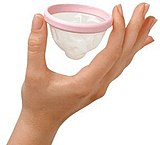
3. Menstrual Cups

These are similar to tampons in the sense that you have to insert them into the vagina.

According to the Keeper's website, it does not cause the Toxic Shock Syndrome as it does not absorb the menstrual blood. It only collects the blood.

This is reusable and can last for 5 to 10 years if well taken care. All one has to do is to wash it after every use. The use of chemicals and boiling in hot water is not necessary at all.

There is also the one-use-disposable menstrual cup.

click on Softcup to view more.


4. Sponges


*** Sea sponges are a natural alternative to tampons that come in different sizes to absorb varying amounts of menstrual flow. On average they cost between $8-15 dollars (each). These are not the same sponges that you might buy in a grocery store to wash dishes with. Sea sponges are actually harvested from the ocean floor and contain no synthetic materials. They are not sterile, however. One sea sponge will last about 6 months, but some may not last as long. A menstrual sea sponge should be thrown away and replaced if you notice that it rips apart while you are inserting or removing it from your vagina. You should follow the instructions that come with the product. Before using a sea sponge, you’ll have to dampen it, squeeze it tightly in your hand, and then gently insert it into your vagina. Once in place, it works like a tampon to absorb menstrual flow.

A sea sponge needs to be rinsed out about every 3 hours and thoroughly cleaned and dried and properly stored at the end of each menstrual cycle. Care must be taken to remove the sea sponge to avoid tearing it. In the 1980s, the FDA (Federal Drug Administration) found that some sea sponges marketed as menstrual products contained potentially harmful bacteria. One sea sponge manufacturer (Sea Pearls™) offers ways to disinfect their product. As with tampons, it is possible to get toxic shock syndrome from sea sponges.

Click on sea-sponge to view more.
Harvesting sea sponges can be damaging to the ecological system.


Saturday, 11 August 2012

Unsanitary Sanitary Issues - Part 2

The Materials & Ingredients Used in Commercially Made Sanitary Pads

1. Wood Pulp Fibers

Fluff pulp is the common name for wood pulp fibers which are used in the absorbent core of sanitary pads and even diapers.

Fluff pulp is a chemical pulp which is most of the time made of bleached cellulose fiber obtained from wood which has long fibers.

* Chemical pulp is created by a method that uses chemicals and heat to convert wood into pulp. This process can be, and generally is, used as an alternative to mechanical pulping, which involves obtaining wood fibers by way of a grinding process.

There are two widely recognized processes for producing chemical pulp. One is known as sulfate pulping. The other is known as sulfite pulping. The major differences between these are the chemicals used, the quality of paper produced, and the economy of chemical recovery.
Sulfate pulping is a process that was developed in Germany in 1879. It is sometimes called kraft pulping because kraft means strength in German, and the paper produced with this chemical pulp is strong. It can be used to make paper bags, writing paper, or diapers. Chemicals are typically always recovered in this process.
click here to read more on chemical pulp

Fluff pulp is also known as fluffy pulp, comminution pulp, and fluffing, this pulp is made from trees classified as softwood, which means they belong to the conifer family, such as pines. Fluff pulp is produced worldwide in huge amounts. Some estimates put annual production in the range of 3.5 million tonnes. It is available in a large variety of grades and is used to create a large array of personal hygiene products.

click here to read more on fluff pulp

2. Rayon

*** Regular rayon (or viscose) is the most widely produced form of rayon. This method of rayon production has been utilized since the early 1900s and it has the ability to produce either filament or staple fibers. The process is as follows:

  1. Cellulose: Production begins with processed cellulose
  2. Immersion: The cellulose is dissolved in caustic soda: (C6H10O5)n + nNaOH → (C6H9O4ONa)n + nH2O
  3. Pressing: The solution is then pressed between rollers to remove excess liquid
  4. White Crumb: The pressed sheets are crumbled or shredded to produce what is known as "white crumb"
  5. Aging: The "white crumb" aged through exposure to oxygen
  6. Xanthation: The aged "white crumb" is mixed with carbon disulfide in a process known as Xanthation, the aged alkali cellulose crumbs are placed in vats and are allowed to react with carbon disulfide under controlled temperature (20 to 30 °C) to form cellulose xanthate: (C6H9O4ONa)n + nCS2 → (C6H9O4O-SC-SNa)n
  7. Yellow Crumb: Xanthation changes the chemical makeup of the cellulose mixture and the resulting product is now called "yellow crumb"
  8. Viscose: The "yellow crumb" is dissolved in a caustic solution to form viscose
  9. Ripening: The viscose is set to stand for a period of time, allowing it to ripen: (C6H9O4O-SC-SNa)n + nH2O → (C6H10O5)n + nCS2 + nNaOH
  10. Filtering: After ripening, the viscose is filtered to remove any undissolved particles
  11. Degassing: Any bubbles of air are pressed from the viscose in a degassing process
  12. Extruding: The viscose solution is extruded through a spinneret, which resembles a shower head with many small holes
  13. Acid Bath: As the viscose exits the spinneret, it lands in a bath of sulfuric acid, resulting in the formation of rayon filaments: (C6H9O4O-SC-SNa)n + ½nH2SO4 → (C6H10O5)n + nCS2 + ½nNa2SO4
  14. Drawing: The rayon filaments are stretched, known as drawing, to straighten out the fibers
  15. Washing: The fibers are then washed to remove any residual chemicals
  16. Cutting: If filament fibers are desired the process ends here. The filaments are cut down when producing staple fibers


***taken from Wiki Rayon

3. Polysorbate-20


*** Polysorbate-20 is fragrance component, a surfactant, an emulsifying agent, and a solubilizing agent.  
Polysorbate starts out as harmless sorbitol, but then it's treated with carcinogenic ethylene oxide.  It's called Polysorbate 20 because it's treated with 20 "parts" of ethylene oxide.  The higher the number, the more ethylene oxide it has been treated with.  This substance is then combined with various fatty acids.  The Skin Deep Database rates it as only a "one," and doesn't pick up on the risk that it could be contaminated with ethylene oxide, and subsequently, 1,4 dioxane.  In addition, it can be laced with heavy metals.
***taken from Chemical of the Day

4. Urea Formaldehyde

Urea formaldehyde (UF) is a cost-effective thermosetting resin that is widely used in the wood product industry. These resins cure easily and are scratch resistant. They are mainly used in the manufacture of pressed wood products.

Formaldehyde is a confirmed carcinogen. It means that it is a cancer causing agent.

click here to read more on Urea Formaldehyde

click here to read on Formaldehyde and Chemical Sensitivity

5. Sodium Polyacrylate

Sodium polyacrylate, also known as waterlock, is a polymer with the chemical formula [-CH2-CH(COONa)-]n. It is widely used in consumer products. It has the ability to absorb as much as 200 to 300 times its mass in water. 

Acrylate polymers generally are considered to possess an anionic charge. While sodium neutralized polyacrylates are the most common form used in industry, there are also other salts available including potassium, lithium and ammonium.

This is also used in baby diapers.

click here to read more on The Use & Effects of Dioxin and Polyacrylate

6. Polypropylene

Polypropylene (PP), also known as polypropene, is a thermoplastic polymer used in a wide variety of applications including packaging and labeling, textiles (e.g., ropes, thermal underwear and carpets), stationery, plastic parts and reusable containers of various types, laboratory equipment, loudspeakers, automotive components, and polymer banknotes. An addition polymer made from the monomer propylene, it is rugged and unusually resistant to many chemical solvents, bases and acids.
In 2008, the global market for polypropylene had a volume of 45.1 million tonnes, which led to a turnover of about $65 billion (~ €47.4 billion).

Polypropylene is a major polymer used in non-wovens, with over 50% used for diapers or sanitary products where it is treated to absorb water (hydrophilic) rather than naturally repelling water (hydrophobic).

click here to read more on Polypropylene

7. Bleach

In order to promote the whiter-than-white, sterile image disposable feminine hygiene products are heavily bleached and treated. Elemental chlorine gas has been a common bleaching agent. This is a source of dioxin, a known human carcinogen. Dioxin is 70,000 times more lethal than arsenic and next to plutonium the most toxic substance known to humans. 

Since an environmental campaign in Great Britain persuaded UK manufacturers to change the bleaching method many now use either chlorine dioxide or hydrogen peroxide.

click here to read more on Dioxin and Its Effects

8. Fragrance or Deodorant

This is an invention whereby a sanitary napkin has an adhesive with perfume carrying release agents. Preferably the release agents are microcapsules that release perfume upon removal of a release liner from the adhesive, and/or during the user's wear of the sanitary napkin, and/or upon the removal of the sanitary napkin from the user's undergarment. The perfume releases are either as fragrance bursts, diffusion or both.

click here to read more on Contact Dermatitis of the Vulva

*** Women with excessive vaginal secretions often use self adhesive pads for comfort and hygiene. A fragrance and disinfecting agent are commonly incorporated into the pad and both may produce contact dermatitis. Sterry and Schmoll reported the case of a woman with genital pruritis who had been using self adhesive pads for several months. Patch testing was positive to the layer of the pad which contained the fragrance and the disinfecting agent (CuII-acetyl acetonate and acetyl acetonate). A similar case has also been described of sensitivity to cinnamic alcohol and cinnamic aldehyde present as a perfume in a deodorant sanitary napkin.

***taken from here


Here are some interesting articles concerning the world of sanitary pads:

Chemicals in Sanitary Pads

Chlorine Bleaching and Dioxin

A Research on Dioxin

Chemicals in Sanitary Napkins

Menstrual Products Go Green


... to be continued

Tuesday, 7 August 2012

Unsanitary Sanitary Issues - Part 1

Sometime early this year, I started to develop a new sensitivity to a product which I have been using since the moment my body hit puberty.

Yup, sanitary pads have been giving me hell every month.

It began with urine infections after every period ended.

Month after month after month.

And then a few months back, the pads started to burn me. The sanitary pads would burn me as though I had salt being poured on an open wound. It certainly brought back all the unpleasant memories of the episiotomy and the severe urine infection I had immediately after the birth of my son seven-and-a-half years ago!

And then the yeast infections started. I have not had yeast infections for years!

I knew the pads were the cause of the problems as they all happened during and immediately after the periods. I would be symptom-free in between periods!

So I started reading and researching what disposable sanitary pads are made of and what they consist of.

The A - Z of A Commercially Made Disposable Sanitary Pad

1. Large amounts of wood pulp fibers are dispersed in a large tub of water. Chemicals and dyes are added to this process.

2. The pulp is then scraped, brushed and inserted with air to make it fleecy.

3. Some pads contain rayon, which also originates from wood for extra absorbency.

4. The cellulose in the wood is dissolved in a caustic solution, and squirted into fine jets in an acid bath.

5. The mixture then solidifies and dries into longer fibers.

6. The pads go through chemical processes which include de-linking recycled material, and washing with detergents.

7. Additives are used to enhance the absorbency of the pads. The absorbency agent and wet-strength agent are polysorbate and area formaldehyde.

8. To reduce the thickness of sanitary pads, sphagnum and super absorbent polyacrylate super absorbent gels which are derived from petroleum are used.

'The materials used to manufacture most pads are derived from the petroleum industry and forestry. The absorbent core, made from chlorine bleached wood pulp, could be reduced to make slimmer products with the addition of polyacrylate gels which sucks up the liquid quickly and holds it in a suspension under pressure. The remaining materials are mostly derived from the petroleum industry, the cover stock used is polypropylene non-woven, with the leakproof barrier made from polyethylene film.' click here

9. All sanitary pads are bleached with chlorine to give them that white, glowing, pristine look.

10. The bottom/back of the pads has strips of pressure-sensitive adhesive covered with a strip of siliconised compound paper.

11. If they are scented pads, fragrance is added.

12. And colourful prints (which are made of dyes) are added to pads today to make them look attractive.

click here to read Sanitary Pads - A Silent Health Threat


... to be continued